How to Find Public Restrooms in NYC: Official Maps, Hours and Accessibility
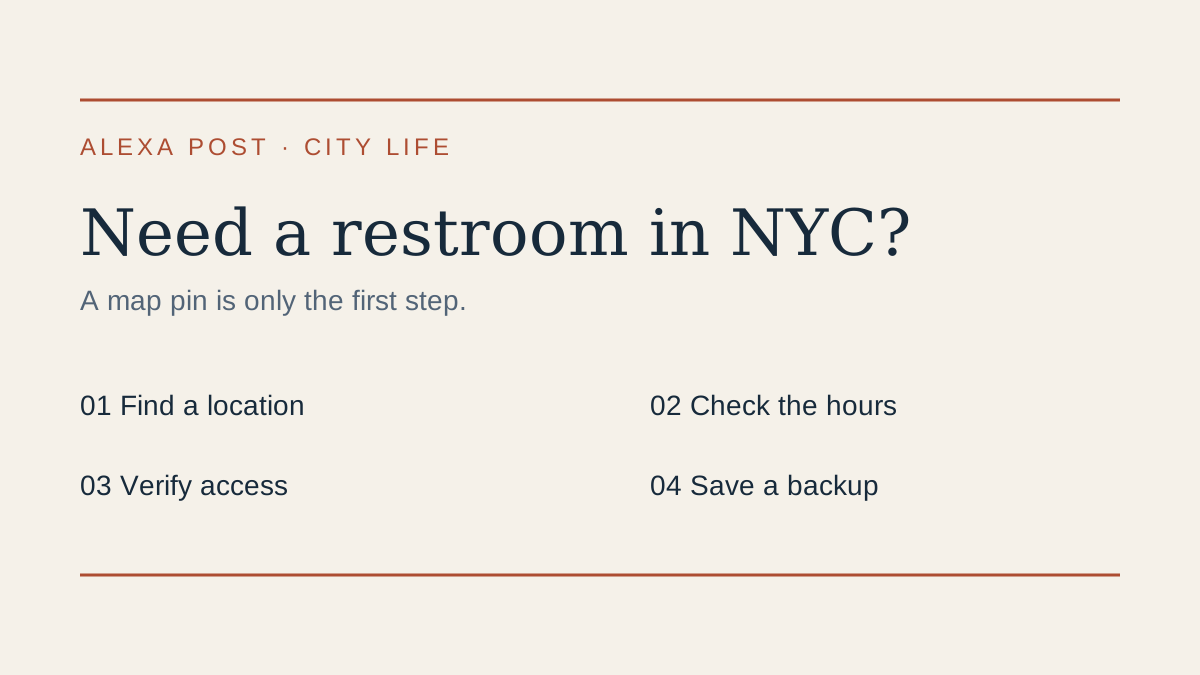
Finding a public bathroom in New York is not simply a matter of spotting the nearest pin. You need a facility that is open when you arrive, an entrance you can actually reach and, where relevant, a usable accessible route. A map is a starting point; those three checks make it useful.
This guide brings together official city resources and explains how to use them without mistaking a listed location for a guaranteed open door. It is a desk-researched service guide, not a claim that Alexa Post has visited or inspected the facilities. Sources were checked on November 10, 2026.
Start here: the official NYC restroom map
NYC311’s Public Restrooms page links to the city’s official public restroom map. The service covers locations in parks, libraries, privately owned public spaces and transit hubs. These are different settings, with different entrances and operating arrangements.
- Search around your destination as well as your current location. A nearby pin on the other side of a station or park may involve an inconvenient detour.
- Open the individual listing. Look for the facility name, address, stated hours and accessibility information.
- Check the operator’s page when timing matters. Use the relevant park, library or station information rather than assuming the map has captured every change.
- Choose a backup before setting off. Save a second plausible location, ideally with a different operator or a later stated closing time.
That last step is our practical recommendation, not a city requirement: two options are more useful than one apparently perfect pin.
Which official resource answers which question?
| Your question | Where to start | What still needs checking |
|---|---|---|
| What is near me? | NYC311’s linked city map | The individual location, entrance and opening hours |
| Which listed facilities might be open at a particular time? | City Council restroom locator | Whether the underlying hours are complete and current |
| How do the street-level DOT toilets work? | NYC DOT Public Restrooms page | Which program serves the specific location and its access instructions |
| Does a particular transit station have a restroom? | The operator’s station information | Restroom hours, entrance and any access restrictions |
| Where should I report a problem? | NYC311 maintenance guidance or the facility operator | Whether it is a park, library, privately owned public space or transit facility |
“On the map” and “open now” are different claims
The City Council’s restroom analysis includes a locator with a time-of-day filter. It also explicitly warns that opening hours may be incomplete or outdated. Treat the filter as a way to narrow your search, not as a live inspection of the door.
The Council’s geographical comparisons are labelled as November 2025 data. They are useful background, but should not be presented as a fresh count of working bathrooms today. A dataset can help explain an access problem without being a real-time availability service.
Before relying on a result, ask three separate questions: Is the facility listed? Is it scheduled to be open at my arrival time? Is there evidence of an immediate closure or access problem? One answer does not automatically establish the other two.
NYC DOT has two programs with different hours
The DOT restroom page distinguishes automatic public toilets from a newer modular restroom pilot. Do not apply one program’s hours to every facility on the city map.
- Automatic public toilets: DOT lists these as free, ADA-accessible single-stall facilities operating from 8 a.m. to 8 p.m. Listed sites include Madison Square Park in Manhattan, Corona Plaza in Queens, Grand Army Plaza in Brooklyn and Fordham Plaza in the Bronx.
- Modular pilot: DOT describes free, accessible units with daily hours of 7 a.m. to 10 p.m., with installation beginning in September 2026. Access options include text message, a QR code or the Throne app. The page also describes a community-partner tap-card option for people without a phone.
A pilot site appearing on the program’s list should not be taken as independent confirmation that installation is complete or the unit is currently available. Follow the specific unit’s posted instructions. If using a phone is difficult, check the stated alternative before making that location your only plan.
For transit facilities, check the station rather than the whole network
Station opening hours, train service hours and bathroom hours are not interchangeable. For a concrete example, MTA’s Harlem–125 Street Metro-North station page lists public restrooms from 6:30 a.m. to 9:30 p.m. daily. That is a station-specific listing, not a timetable for every MTA restroom.
When checking another station, look for a separate restroom entry and verify the relevant entrance. If the page does not explain whether you must pass a fare gate or another controlled area, do not infer unrestricted access from the presence of a bathroom symbol.
Accessibility: look beyond the symbol
An accessibility label is helpful, but your trip may depend on more detailed information. Check the approach to the building, the entrance and the route to the restroom. If you need a particular feature, such as a changing facility or enough room for assistance, look for an explicit description rather than treating a generic icon as confirmation.
For someone planning around mobility or caregiving needs, a slightly farther facility with clear access information may be a more practical choice than the closest location with missing details. This is a planning judgment, not a guarantee about either site.
A quick checklist before you walk
- Save the facility name and address, not just a screenshot of a pin.
- Compare your expected arrival time with its stated closing time.
- Check the entrance and any phone, card or fare-gate requirements.
- Keep a second option whose hours also fit.
- If a facility is closed or poorly maintained, use NYC311’s operator-specific reporting links.
Sources and limits of this guide
We compared NYC311’s location and reporting guidance, NYC DOT’s two restroom programs, the City Council’s locator documentation and an MTA station listing. Our contribution is the comparison and planning workflow; we did not conduct on-site checks, test the access systems or independently verify cleanliness. Linked maps may require JavaScript, and conditions can change after this source check.
Looking instead for a paid bathing or sauna experience? Our NYC bathhouse and sauna guide covers a different need: wellness venues rather than public restroom access.


