
A Brooklyn Bagel Shop Is Cutting $10K a Year From Its Electric Bill With Plug-In Batteries
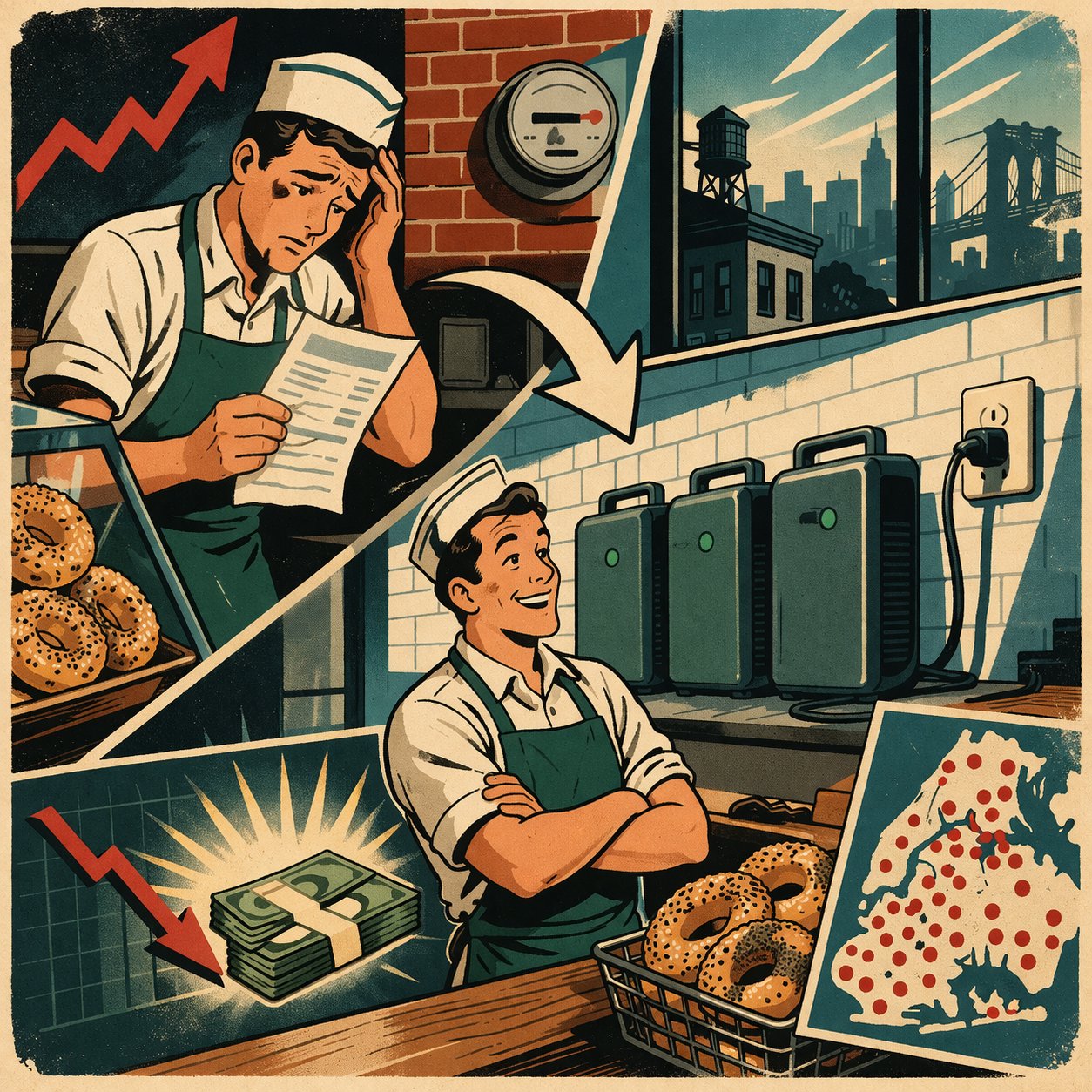
Black Seed Bagels in Bushwick has three suitcase-sized batteries plugged into the wall behind its kitchen. Startup David Energy supplies them for free, controls when they kick in, and both sides save money. The program has already expanded to 50 NYC locations.
In the back of Black Seed Bagels in Bushwick, past the industrial-size condiments and the freezers full of dough, there is a tall, silver electric oven called the Baconator. It cooks thousands of pounds of meat every week to go with Black Seed's hand-rolled, wood-fired bagels. And it is connected to a battery the size of a carry-on suitcase, plugged into the wall.
Two more batteries are paired with energy-intensive refrigerators in the front of the shop. While the morning rush is underway, these 2.8-kilowatt-hour batteries can directly power the commercial oven and the fridges, reducing the shop's reliance on the electrical grid during the most expensive moments of the day.
It sounds simple because it is. And that simplicity is the point.
The hidden cost that eats half your electric bill
Most New Yorkers think of electricity bills as straightforward: you use power, you pay for the kilowatt-hours. But for commercial customers in New York City, there is another charge that can dwarf the actual energy cost. It is called a demand charge.
A demand charge is based on the maximum amount of power your business draws from the grid during any single 15-minute window in the entire month. One bad quarter-hour, and your bill goes up for 30 days. For NYC businesses, demand charges can represent between 15% and 50% of the total monthly Con Edison bill.
A bagel shop running ovens, refrigerators, and air conditioning simultaneously during a July morning rush can spike its peak demand and pay hundreds of extra dollars that month because of those 15 minutes.
How the batteries work
The batteries come from David Energy, a New York-based retail energy provider that supplied them to Black Seed for free last August. David Energy's software platform controls exactly when each appliance switches from grid power to battery power. The business owner does not need to think about it.
When the shop's power demand is about to spike (ovens heating up during morning rush, AC kicking in on a hot day, all the fridges running at once), the software switches the heaviest appliances to battery. The grid sees a lower peak. The demand charge drops. The monthly bill goes down.
According to David Energy CEO James McGinniss, every kilowatt shaved from that 15-minute peak can cut about $50 from a monthly bill. For Black Seed, with 10 locations across NYC, even modest savings of $80 per shop per month would add up to nearly $10,000 a year in avoided utility costs.
By the numbers
- Battery size: 2.8 kWh each, about the size of a carry-on suitcase
- Cost to the business: Free (David Energy supplies and controls them)
- Savings per kW of peak reduction: ~$50/month
- Potential annual savings for Black Seed (10 locations): ~$10,000
- Demand charges as % of NYC commercial bills: 15% to 50%
- David Energy locations signed (as of Jan 2026): ~50, with 500+ kWh of storage
Why plug-in? Because of the FDNY
There is a reason David Energy uses portable, plug-in batteries instead of permanently installed ones. New York City's fire safety regulations, enforced by the FDNY, have subjected stationary lithium-ion battery installations to rules so strict that they are impractical for most commercial buildings. The permitting and interconnection process alone can take months and cost thousands.
Plug-in batteries sidestep the entire process. They do not require special permits, electrical work, or fire department approval. You plug them into a standard wall outlet. If a customer leaves the program, David Energy simply picks the battery up and moves it to the next location.
This is what makes the model scalable in a city where building regulations can kill good ideas before they start.
How David Energy makes money giving away free batteries
The obvious question: why would a startup give away hardware for free?
David Energy is a retail energy provider, not just a battery company. The batteries help them attract and retain customers (lower bills make for happy clients), but the real business model goes further. David Energy can use the same stored battery power to earn revenue by participating in demand-response programs.
These programs, run by the New York Independent System Operator (NYISO) and Con Edison, pay businesses to reduce their power consumption during grid stress events, typically on hot summer evenings when everyone's air conditioning is straining the system. David Energy can aggregate the battery power across dozens of locations and get paid for the load reduction, effectively turning each suitcase-sized battery into a tiny piece of a distributed power plant.
The company has also raised $23 million in funding, positioning itself as what the energy industry calls a virtual power plant: a network of small, distributed energy assets that collectively act like a traditional power plant but without the smokestacks.
Beyond bagels: who else is plugging in
Black Seed Bagels is not the only NYC business in the program. As of mid-January 2026, David Energy had signed deals for about 50 locations with more than 500 kilowatt-hours of total storage capacity. The customers range from fast-food restaurants to a day spa to a dog grooming shop, where the battery cushions the power draw of a commercial fur-drying machine.
The model is part of a larger trend in energy technology: plug-and-play solutions that do not require a contractor, an electrician, or a permit. Think of it as the energy equivalent of what WiFi did for networking. You do not need to run Ethernet cables through your walls anymore. Similarly, you do not need a full electrical installation to start managing your energy costs. You just plug something in.
Vivek Bhagwat, David Energy's head of engineering, expects the batteries to be especially valuable during the summer months, when air conditioners run around the clock and demand charges spike. The refrigerators, which never turn off, are a constant source of demand that the batteries can absorb quietly in the background.
What it means for NYC small businesses
New York City's electricity costs are among the highest in the country. For small businesses operating on thin margins, the difference between a $1,200 and a $1,000 monthly electric bill is not trivial. Multiply that by 12 months and 10 locations, and you are talking about real money.
The plug-in battery approach will not eliminate anyone's electric bill. But it attacks the most frustrating part of it: the demand charge, which most business owners do not understand, cannot control, and often do not even know exists until they look at their bill closely.
If David Energy's pilot proves out across its 50 initial locations, the concept could spread to thousands of NYC small businesses. The ingredients are all there: high demand charges, strict fire regulations that favor plug-in solutions, a dense urban environment where small savings at scale add up fast, and a startup willing to give the hardware away to build a network of distributed energy assets.
For now, the Baconator in Bushwick is cooking bacon on battery power. And Black Seed's electric bill is a little lighter for it.

Comments (0)
No comments yet.
Leave a Comment